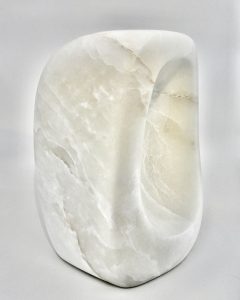
Ocean and Sky, Italian ice alabaster, 2025. Robin MacDonald-Foley
It was early April; my tool shed was prepared, the snow was gone, and I’d been thinking about a piece of alabaster still in its shipping box from California. I’d left it sitting on my three season porch, the exact location where I’d originally placed it. I recall the day the alabaster arrived—a cold afternoon last December. My husband and I were both home when UPS pulled up. “It must be my stone!” I yelled out. The driver surveyed the entrance to our long driveway. I opened the door to let him know it was OK to leave my package at the bottom of the steps, but he came right up to me with my stone in his arms.
The Italian Ice Alabaster weighed sixty pounds. I thought about the alabaster’s travels from west to east coast as I anxiously opened the heavy cardboard box. I sliced down two sides of the box with a utility knife to get the first peek, smiling when I saw my name—hand written by my stone supplier. I love the personal touch that connects us to such desired stones. “You will be my first carving after winter,” I revealed, letting my intention known. As the December afternoon sunlight streamed through the porch windows exposing the alabaster’s brilliance, I stood back for a better look, then re-taped the box shut. “You’ll be safe until spring,” I said.
On that day in early April, I placed the alabaster on my two wheeler, rolled it down the porch ramp directly to my studio, then lifted it up onto one of my carving benches. In the bright daylight I noted the translucent coloration; white with gray-red veining which is actually mineral deposits that form in the stone. Occasionally, these deposits become a crack, but not necessarily a break. The finer qualities of this type of alabaster more than make up for any potential flaws. This kind of stone is also softer to carve and very popular among sculptors. Besides, I knew the final polish would radiate an ethereal glow and I would love it because of the frosted glass-like appearance that Italian Ice is known for.
The unknowns to any stone are revealed over time—each carving session exposing a bit more. Tools in both hands, I strike right hand with my hammer and left hand guiding a point or chisel, hovering over, touching the surface with precision. This alabaster feels like a reflection of myself, as though I’m looking in. As a carver, I’m always asking questions of my stones, most significantly: “When do I know I have done enough? When is the endpoint?” With the alabaster, I found myself asking: “What do you think of me?” Seeing myself in its mirror-like surface, I study its beauty and faults but dread that it may break off unexpectedly. It’s almost a love-hate relationship that I don’t know how will end. Each day, each hour, over weeks and months, I begin to feel the stone’s internal nature.
The more stones I have, the more I want and I’ve always felt the need to have a good selection to bring concepts to life as they unfold in real time. The stones huddle together in bins and more are strewn about the floor of my stone shed. They become stones in waiting, their stories yet to be told. Type, color, shape, texture—it all draws me in. Then, once in my studio, they’ll sit a while until I make choices based on my own ideas, or until they speak to me with urgency. Vertical or horizontal, base or no base. The hardness of the stone dictates the tools. Those are the basics. I complete two sculptures a season, maybe three. It takes me over two years to have a solid body of work prepared for a solo show.
I always wanted a piece of stone from Italy, and I happen to like Ice Alabaster, so I really thought this was the perfect fit to be something special. From Italy to California, the alabaster happened to land in my studio waiting to become something. Each pass of the tool, each grind of the file, I’ll get to know this stone. Eventually, the alabaster began to resemble clouds in the sky and the ocean.
The alabaster challenged me, however, when an important chunk broke off. So close was I to that magical place where the tedious work of polishing begins, the stone’s shape already defined. But alas, as I wrapped up my day and turned the alabaster around to admire it from front to back, I acknowledged a deposit, one I’d seen many times before—but I thought we were safe. I was wrong. Suddenly, a piece near the bottom just blew off into the garden. Not a tool in sight. I was at once lost for words. “What was that for?” I shouted in a state of shock. The stone replied; “Hey, remember you left me cold and unwanted for months. Sorry: I had to vent. You took too many risks. I cracked.”
I decided not to visit the alabaster for days—until I accepted its flaws and it promised me a beautiful finish. “We’re almost there now, it’s OK. I’ll not push or bruise your under layers.” As I slowly grew to understand the alabaster’s features and unpredictability, I was reminded that it is not the first stone to break, and I’m sure it will not be the last. Even though I was horrified at first, reworking the broken area mended our spirits and we truly bonded in the process. With endless patience and trust, we agreed on a slightly different twist. I now admire the alabaster more than ever!
Stones in Waiting ~ Published in Volume 10, Interiors: An Anthology of Personal Essays by the Mission Hill Women’s Writing Group. Winter 2025 – 2026. Coach and Editor: Theresa Okokon.